
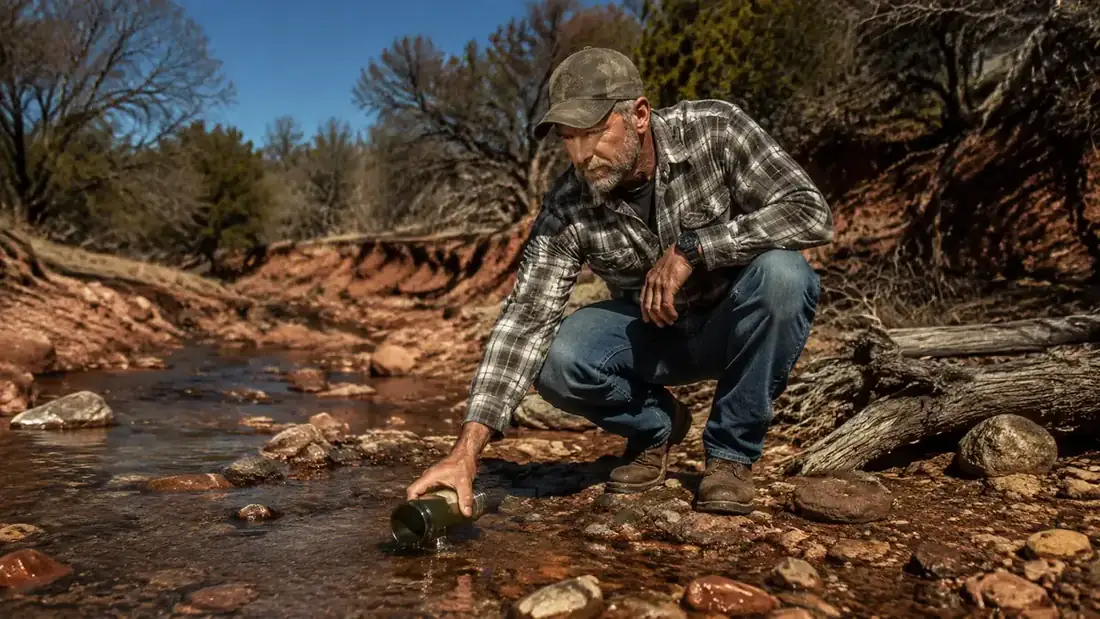
Every review of the Katadyn BeFree I read before I bought mine made it sound like a miracle in a soft plastic bag. Fill it, squeeze it, drink clean water in under a minute, no pump handle, no waiting on a gravity bag while you set up camp. All true, as far as it goes. What none of those reviews mentioned is what happens on fill number thirty, or what happens when the only water around is four inches deep and running slow, or what happens when it drops below freezing and you forgot the thing was still full.
I've been running a Katadyn BeFree since late winter, mostly off the tailgate of my truck on land I hunt and fish around here in Oklahoma, plus one archery elk trip out to Colorado where I leaned on it hard for five straight days. It's a good filter. I'm not writing this to talk you out of it. I'm writing it because I got burned expecting the same clean, easy experience I'd read about, and I'd rather you go in knowing the parts that don't make the highlight reel.
The Quick Verdict
The BeFree does exactly what it promises on clean, deep water. It's the shallow water, the sediment load, and the cold nights where the marketing goes quiet, and that's the part worth knowing before you're standing at a creek with it.
Amazon Check Today's Price →Nobody tells you the flow rate on the box is a best-case number. I'll show you what the worst case actually looks like.
The Katadyn BeFree is still the filter I reach for first. But knowing its real limits before you buy one saves you a frustrating first trip. Check today's price and decide for yourself with the full picture.
Amazon Check Today's Price on Amazon →How I Put This Thing Through Real Water
My testing wasn't controlled and it wasn't gentle. I filled this flask out of a muddy stock tank behind my place that my cattle drink from, out of the Kiamichi River on a scouting trip for trail camera placement, and out of a beaver pond in Colorado that was more mud and duckweed than open water by the time archery season rolled around. None of that is the clear mountain creek water you see in the product photos, and I did that on purpose.
I also didn't treat it like a piece of expensive gear that needed babying. It rode in a truck door pocket for two weeks straight, got left in the sun on a tailgate more than once, and spent five days in a hunting pack getting jostled against a rangefinder and a set of pruning shears. If a filter can't take that kind of ordinary rough handling, I don't want it in my truck to begin with.
Over about four months I put somewhere around sixty fills through mine, across everything from that clear stretch of the Kiamichi to standing cattle-tank water thick enough to leave a film on the flask when it dried. That range of water quality is where the honest picture of this filter actually shows up, not in a single clean creek crossing on a sunny afternoon.
A buddy of mine who joined me for two days of that Colorado trip carried an old bladder-style pump filter, and we ended up filling side by side at the same beaver pond more than once just out of curiosity. On that duckweed water, his pump took longer per liter but the effort stayed roughly the same fill after fill. Mine started faster and ended up slower and harder than his by the second day, which told me something the spec sheet never will: a squeeze filter and a pump filter age differently under a real sediment load, and the BeFree's early speed advantage shrinks the dirtier the water gets.
The Flow Rate on the Box Doesn't Last as Long as You'd Hope
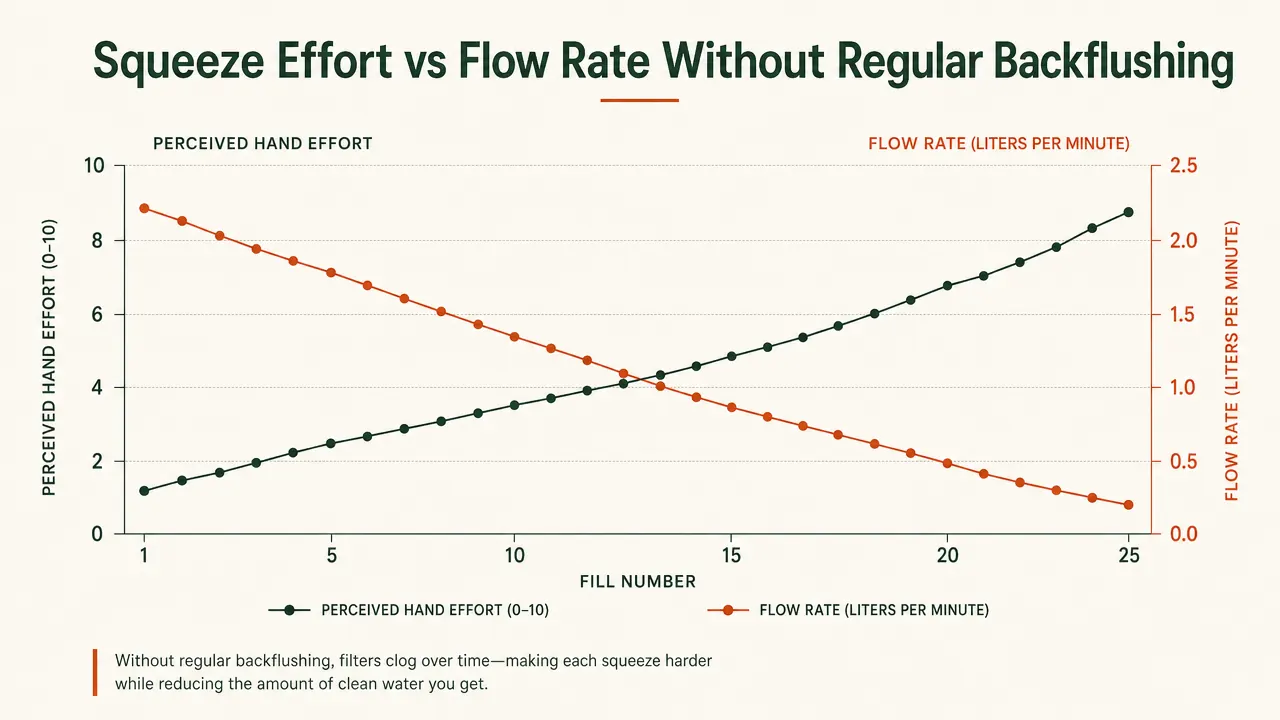
Katadyn's number is up to two liters a minute, and out of that clear stretch of Kiamichi River water, fresh out of the package, I believe it. My first handful of fills were quick, close enough to that advertised number that I had no complaints. That's the version of this filter everybody reviews, because that's the version everybody tests on day one.
That is not the version you'll be squeezing by fill twenty. Once I started running it through the stock tank water and that duckweed-choked beaver pond, the squeeze got noticeably harder within a handful of uses, not a hundred. By around fill twenty-five out of that dirtier water, I was working both hands and bracing the flask against my knee to get a decent stream going, and my forearm was legitimately tired by the time I'd filled two liters for camp. That's not a defect. That's just what a hollow fiber membrane does when it's asked to strain out real sediment instead of the clean water in the demo video.
The backflush syringe that comes in the box helps, and I'll give Katadyn credit for including it standard instead of selling it separately. But it only helps if you actually use it, and I'll admit I went almost three weeks on that Colorado trip without backflushing because I didn't want to dig the syringe out of my pack at the end of a long day. By the time I did, the difference in squeeze effort was night and day. If you're the type who skips maintenance when you're tired, budget for a noticeably harder squeeze the longer you go between backflushes, because that part of the experience never made it into a single review I read beforehand.
I started timing fills on my phone once I noticed the slowdown, mostly so I wasn't just guessing. Fresh out of the package, a liter of Kiamichi River water took about forty seconds. By fill twenty-five out of the beaver pond, the same liter took closer to three minutes, and that's with me actively working the flask instead of just squeezing steady. That's not a small difference when you're trying to get water for camp before it gets dark, and it's the kind of number that only shows up if you actually track it instead of trusting your memory of how fast it felt on day one.
Filling It in Shallow Water Is Its Own Skill Nobody Warns You About
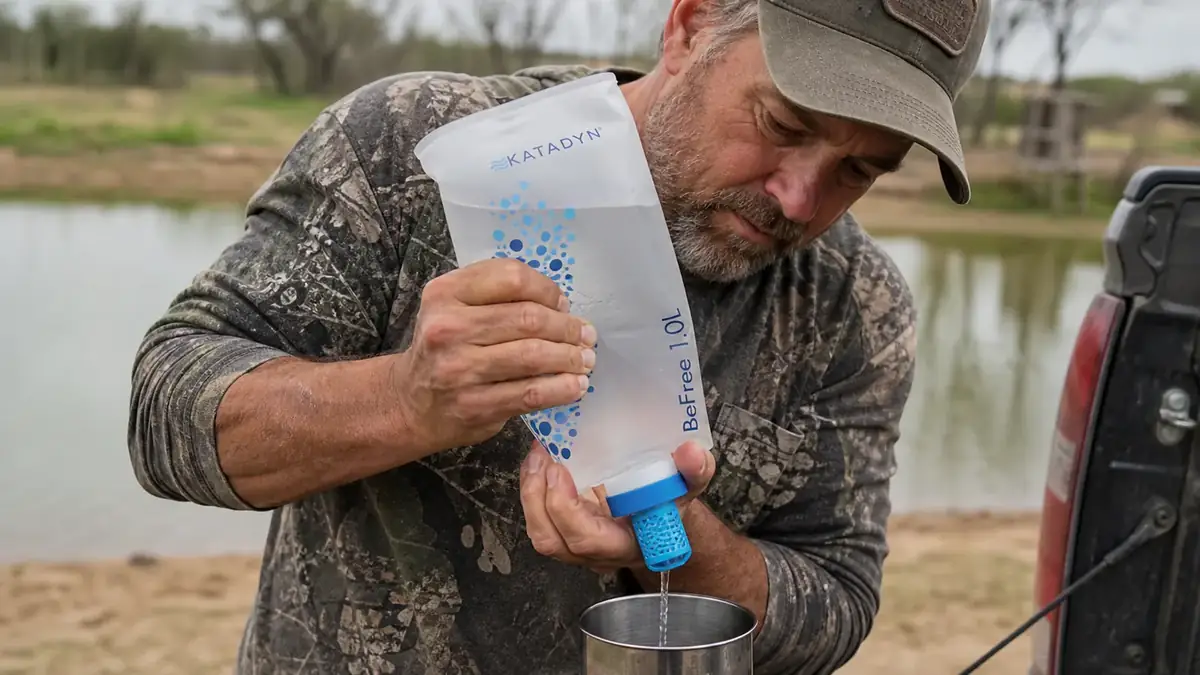
This is the one that actually frustrated me the most, and I never once saw it mentioned before I bought mine. The BeFree fills great when you can dunk the whole flask into a foot or more of moving water and let it billow open. Half the water sources I actually use around here, and plenty in Colorado too, aren't that deep. A lot of Oklahoma creek beds in late summer are four to six inches of slow water running over rock, and a stock tank might only have standing water a few inches from the bottom once it's been dry a while.
In that shallow water, you can't just dunk the BeFree and walk away. You end up tilting the flask almost sideways, working it back and forth to scoop water into the opening a little at a time, and it takes real patience to get even half a liter without sucking up gravel and sand off the bottom in the process. I learned to carry a spare bandana specifically to lay over the opening as a crude pre-filter in that situation, which isn't something Katadyn tells you to do, it's just something I figured out after getting more grit in my flask than I wanted.
None of this makes the filter bad. It makes it a filter that assumes you've got decent depth to work with, and plenty of real backcountry and ranch-country water sources just don't offer that. If your usual water sources are shallow, slow-moving, or seasonal, plan on this being slower and more hands-on than the two-minute unboxing videos suggest.
The worst version of that happened before sunrise on the second morning of the Colorado trip, when the only water within a quarter mile of camp was a trickle running off a snowbank, barely wide enough to wet the bottom of the flask. Getting two liters out of that trickle for coffee and oatmeal for two grown men took close to twenty minutes of tilting, scooping, and waiting, standing in the cold the whole time. A pump with a hose you can drop into two inches of moving water would have handled that trickle a lot faster, and that's a real tradeoff nobody mentions when they're only ever filtering out of a wide, deep creek for the photos.
It Doesn't Thread Onto the Bottles You Probably Already Own
This is a small thing that turned into a genuine annoyance. I assumed, because the filter cap threads onto something, that it would thread onto my standard wide-mouth Nalgene bottles the same way half my other gear does. It doesn't. The BeFree's threading is sized for Katadyn's own flask and a handful of specific Hydrapak bottles, and it will not screw onto a regular wide-mouth or narrow-neck bottle you probably already own without buying a separate adapter that isn't included in the box.
That mattered to me on the Colorado trip because I'd packed a hard-sided bottle as backup in case the flask took a puncture, thinking I could just swap the filter cap onto it if that happened. I couldn't. The threads didn't match, and I found that out at camp instead of at home, which is exactly the wrong time to learn it. If you're planning to rely on this filter with bottles you already own, check the threading before you're standing there trying to force a cap that clearly doesn't fit.
After that trip I actually pulled up Katadyn's own compatibility list to see what does thread on, and it's a short one, mostly their own flasks and a couple of specific Hydrapak models sold separately. That's fine information to have, but it's the kind of thing you have to go dig for yourself, because it isn't printed anywhere on the retail packaging in a way that would stop you from assuming, like I did, that a standard thread is a standard thread.
Cold Weather Isn't a Footnote, It's a Genuine Chore
Katadyn does mention, somewhere in the fine print, that you shouldn't let the filter freeze once it's wet. What they don't spell out is how much of a nightly chore that actually becomes once temperatures start dropping. On that Colorado archery trip, overnight lows in camp were consistently in the twenties, and that meant the BeFree came into the sleeping bag with me, every single night, without exception, because the alternative was a cracked membrane and no way to know it had happened until my next fill came out weak or not at all.
That's not a huge ask on paper, but five nights in, sharing a mummy bag with a wet flask that's cold against your leg gets old. I also had to remember to shake out as much water as I could before bed each night, because the more water sitting in the fibers, the more risk if I somehow didn't get it warm enough. It's a small routine, but it's a routine you don't get a break from, not one night, for the entire length of a cold-weather trip.
Back home, I also learned not to leave it in the truck overnight once fall hit. My truck sits outside, and an Oklahoma November night can dip well below freezing even when the daytime highs are mild. I left mine in the console one night out of laziness and found the flow noticeably weaker the next fill. It still worked, but I wasn't confident it was filtering as well as it should have been, and I've made a point of bringing it inside ever since. That's a habit change nobody mentions until you've already made the mistake once.
What I Liked
- Genuinely fast on clean, deep water, no argument there
- Backflush syringe included standard, and it works if you actually use it
- Packs down to almost nothing compared to any pump filter I've carried
- Held up fine to real truck-and-pack abuse over four months
- One-handed operation at the water source, no setup required
Where It Falls Short
- Squeeze effort climbs fast once sediment or algae load up the membrane
- Shallow water fills are slow, awkward, and prone to picking up grit
- Threading doesn't fit standard wide-mouth or narrow-neck bottles you likely already own
- Cold weather turns into a nightly routine of sleeping with a wet flask
- No patch kit included if the soft flask ever punctures
The flow rate on the box is a best-case number from a clean creek on a sunny day. Sixty fills through stock tank water and a duckweed pond told me the real story.
Who This Is For
If most of your water sources are creeks, rivers, or lakes with decent depth, and you're willing to backflush on a schedule instead of waiting until the squeeze gets hard, the BeFree earns its keep. It's light, it's fast when conditions cooperate, and once you know its habits it stops being frustrating and just becomes part of the routine. Hunters and hikers who move camp often and don't want to babysit a pump filter will still come out ahead with this one.
It's also a solid pick if you're realistic about buying the matching bottles or sticking with the included flask, rather than assuming it'll thread onto whatever you've already got in your gear closet.
Who Should Skip It
If your usual water sources run shallow, seasonal, or heavy with sediment, like a lot of the stock tanks and low-water creeks I deal with here in Oklahoma, you're going to fight this filter more than you'll enjoy it. Same goes for anyone doing serious late-season or winter trips who doesn't want a nightly chore of drying and warming a wet flask, or anyone who's already invested in a set of standard wide-mouth bottles they were hoping to filter straight into without an adapter.
Now you know what the glowing reviews leave out. Here's what to actually expect.
The Katadyn BeFree still earned a permanent spot in my truck, sediment, shallow water, and cold nights included. Just go in knowing the real routine instead of the highlight reel. Check today's price before your next trip.
Amazon Check Today's Price on Amazon →