
I bought my Vortex Crossfire HD 10x42 the week before archery season opened last year, mostly because the pair I'd been borrowing from my brother-in-law finally went back to him. I needed my own glass, and I needed it before I found myself squinting at a shape in a cedar thicket wondering if it had antlers or if it was just a stump doing its best impression of one. Eleven months and one full deer season later, these binoculars have been strapped to my chest more mornings than not, through frost, through a July scouting trip that hit 96 degrees by 9am, and through one memorable dunk in a stock pond I'd rather not relive.
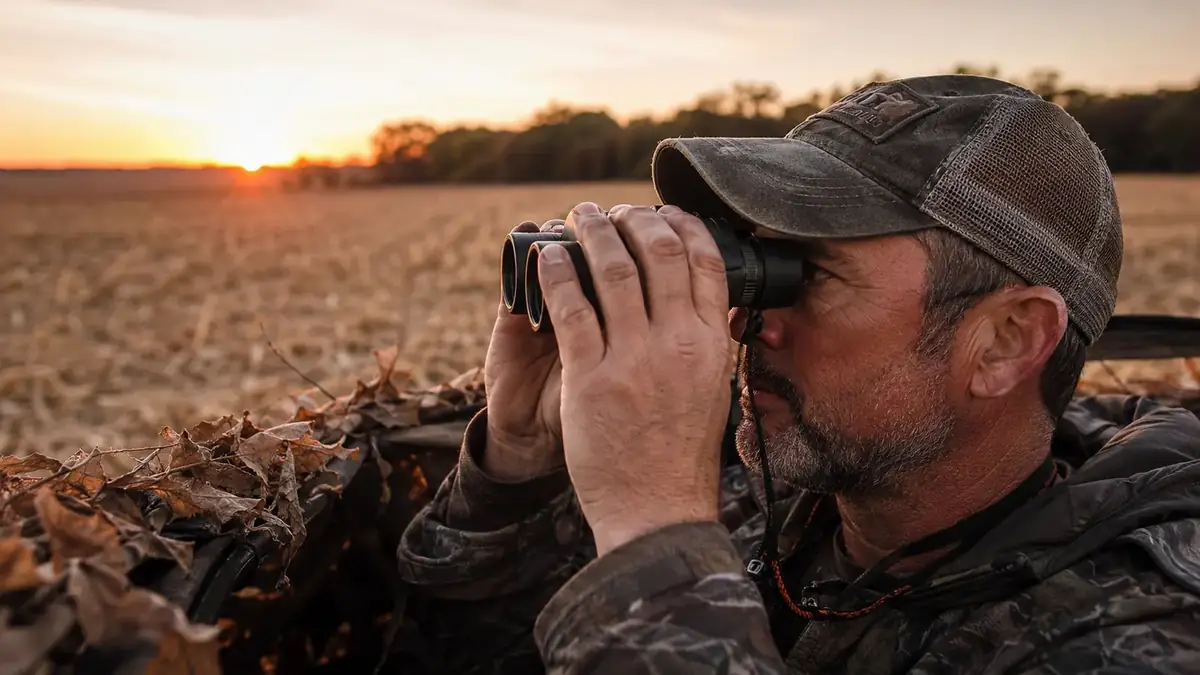
The first real test came on October 28th, sitting on the edge of a cut milo field with my back against a cedar post, watching a heavy eight-point work a fence line about 300 yards out. It was that flat gray light right before sunrise, the kind that swallows detail on cheap glass. I could still count points on that buck through the Crossfire HD before I could've made him out with my naked eye, and that one look told me more about these binoculars than any spec sheet ever could.
This isn't a spec-sheet review. I'm not going to tell you the field of view number and call it a day. I'm going to tell you what it's like to actually hunt with this pair of binoculars day after day, week after week, because that's the only review that ever helped me buy anything.
The Quick Verdict
After a full season of daily use, the Crossfire HD earns its keep on glass quality and warranty alone, even though the weight and the close-focus distance are real tradeoffs worth knowing about up front.
Amazon Check Today's Price →Still glassing with binoculars that fog up the second the temperature drops?
The Vortex Crossfire HD 10x42 is the pair I reach for every single time I leave the truck now, rain, shine, or that one morning it was sleeting sideways. Check today's price and see why it's become the standard recommendation I give every hunting buddy who asks.
Amazon Check Today's Price on Amazon →How I've Used It
My use case is pretty simple. I glass bean fields and cut milo for whitetail in the early mornings and evenings, I've used this same pair on two elk trips to the panhandle of Oklahoma into New Mexico, and the rest of the year they ride in the truck for general looking, whether that's checking cattle in the back pasture or watching a hawk work a fence line. That's a lot of hours behind glass, easily 200-plus by my rough count, across every kind of weather this part of the country throws at you.
I didn't baby them either. They've ridden in a chest harness through brush, gotten rained on more than once, and taken a hard knock against a tree stand ladder that I was sure had cracked something. Nothing did. That's the kind of test that actually tells you something, not a controlled bench review.
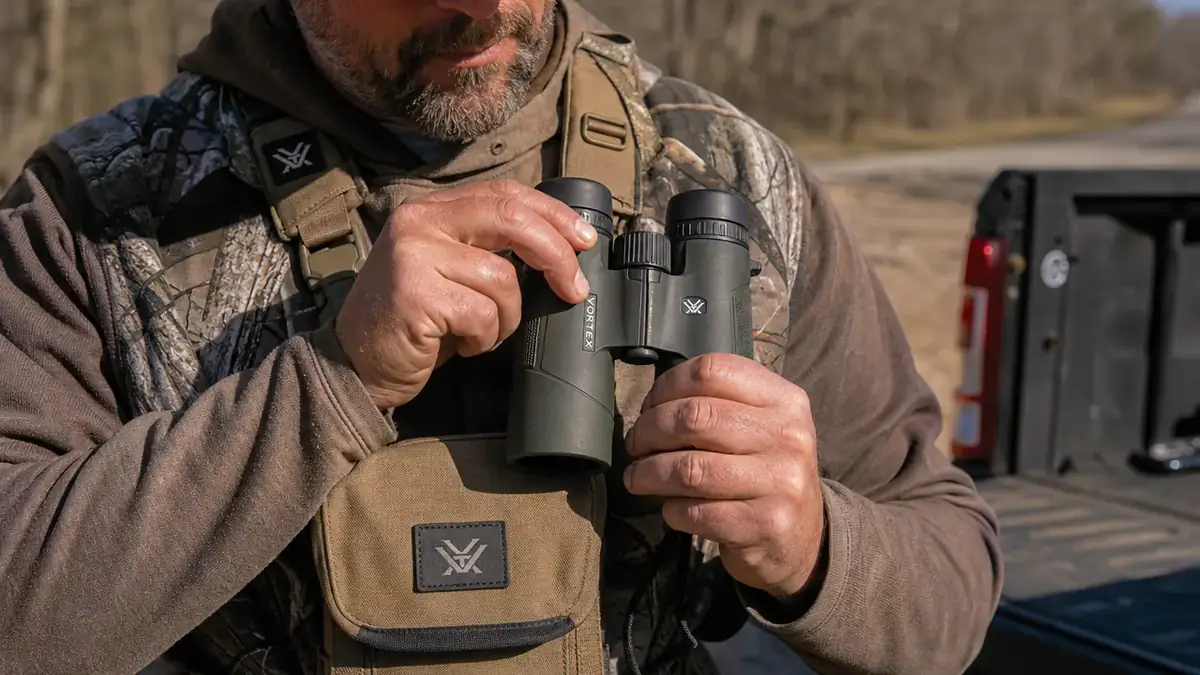
The GlassPak harness that comes with the Vortex Crossfire HD deserves its own mention here, because it's the difference between binoculars you actually wear and binoculars that stay in the truck. I've gone through cheaper binoculars before that came with a flimsy neck strap that dug into my collarbone by 8am. This harness distributes the weight across your shoulders instead, and after a full morning of sitting and glassing, that matters more than people expect.
The Glass Itself: HD Optics in Real Conditions
Here's where the Crossfire HD earns its name. Vortex uses extra-low dispersion glass in this lineup, which in plain terms means the image stays sharp and true to color instead of getting that greenish or purple fringe you see around high-contrast edges on cheap glass. I noticed it most glassing a buck against a bright sky right at first light. The antlers stayed crisp instead of smearing into a halo like they did with the old pair I used to borrow.
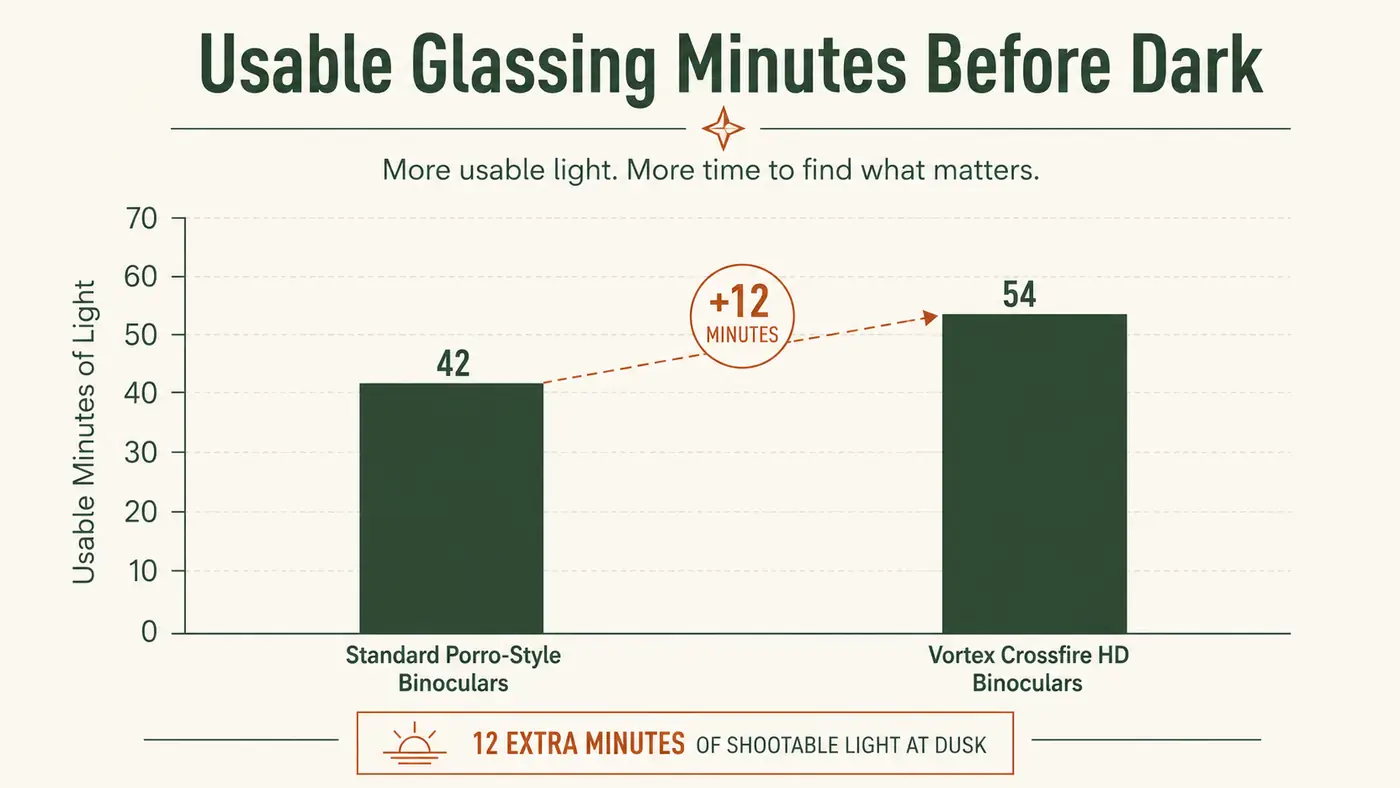
Low light performance is honestly the category that matters most to a whitetail hunter, because the best 20 minutes of the day happen right as legal shooting light is running out. I've pushed these binoculars right up to the edge of legal light more times than I can count, and they hold detail longer than I expected for a pair in this range. That said, I want to be straight with you: they are not going to out-glass a $1,000 pair of Zeiss or Swarovski once true dusk sets in. Nothing at this level does. What they do is buy you an extra ten or fifteen minutes of usable light compared to the entry-level porro-prism binoculars most guys start out with, and in whitetail season, those minutes matter.
The multi-coated lenses also handle glare better than I expected. Glassing across a pond or a wet bean field with the morning sun coming in low used to wash out my old binoculars completely. The Crossfire HD cuts a good amount of that glare, though I'll be honest, it doesn't eliminate it. Point these almost directly into a low sun and you'll still get some washout. That's physics, not a flaw unique to Vortex, but it's worth knowing before you're relying on them at a bad angle.
Tripod Adaptability for Long Glassing Sessions
One feature I didn't think I'd use much when I bought these turned out to be one of the biggest reasons I still reach for them. The Crossfire HD is tripod adaptable, and on those long elk glassing sessions where you're sitting on a ridge scanning a basin for two or three hours straight, hand-holding gets tiring fast and your image starts to shake more than you'd like. I picked up a cheap tripod adapter for less than the cost of a box of shells, mounted the binoculars, and suddenly I could sit and scan a whole hillside without my arms burning out halfway through the second hour.
It's a small thing, but it changed how I hunt open country. Instead of glassing in short bursts and resting my arms, I can leave the binoculars mounted and set up a rotation between me and whoever I'm hunting with, taking turns picking apart the same drainage from different angles. For anyone doing serious western glassing, that adapter is worth the extra few dollars, even if you don't think you'll use it.
Build Quality and Handling After a Full Season
The rubber armor coating has held up better than I expected given how rough I've been on them. There's a scuff on the right barrel from that tree stand ladder incident, and a small scratch near the focus wheel from setting them down on a rock without thinking, but structurally they're tight. No rattle, no play in the hinge, no fogging even after that pond incident where I fell in up to my knees and the harness dunked with me. They're waterproof and fogproof by design, purged with nitrogen, and I can confirm that claim held up under conditions I didn't plan for.
The center focus wheel is smooth and turns with just the right amount of resistance. Not so loose that it drifts when it's in the harness bouncing against your chest while you walk, not so stiff that you're wrestling it when a deer steps out and you need to dial in fast. That balance matters more than people think until they've used a pair where the focus wheel is either too loose or too tight.
Where I'll ding it a little is weight. At right around 23 ounces, the Crossfire HD is not the lightest 10x42 on the market, and after a full-day sit in a ladder stand with the harness on, I do notice it on my neck and shoulders by the end of the day. It's not unbearable, and the harness helps a lot, but if you're doing multi-day backcountry elk hunts where every ounce in your pack matters, it's worth factoring in.
The Warranty Nobody Talks About Enough
I haven't had to use it, and I hope I don't, but Vortex backs the Crossfire HD with their VIP warranty, unlimited lifetime, unconditional, no receipt required, transferable if you ever sell the pair. I've read enough forum threads and talked to enough guys at the sporting goods counter to know Vortex actually honors this. One buddy of mine cracked the housing on an older Vortex pair dropping them off a four-wheeler, mailed them in with zero paperwork, and got a replacement pair back within a few weeks, no argument, no hassle.
That kind of backing changes how you use a piece of gear. I don't baby these binoculars in the field because I know Vortex has my back if something actually breaks. It's a different relationship with a piece of equipment than I've had with any other binoculars I've owned, and honestly, it's a big part of why I'd buy this brand again even if a competitor matched the glass quality.
Who This Is For
If you're a whitetail hunter who glasses fields and tree lines at dawn and dusk, or you're heading out west for elk and need something that handles long glassing sessions without breaking the bank, the Crossfire HD is a legitimately solid choice. It's also a smart pick for someone who's rough on gear or hunts in unpredictable weather, because the build quality and the warranty both back you up when things go sideways. First-time binocular buyers who don't want to overspend before they know how much they'll actually use them will get more capability here than they probably expect for the money.
What I Liked
- HD glass genuinely extends usable light at dawn and dusk compared to entry-level porro-prism binoculars
- Rubber armor and waterproof/fogproof build have held up to real abuse, drops, rain, and one accidental pond dunk
- GlassPak harness distributes weight far better than a standard neck strap for all-day wear
- Unlimited, unconditional VIP warranty that Vortex actually honors
- Smooth, well-weighted center focus wheel that doesn't drift or stick
- Tripod adaptable, which makes long glassing sessions in open country far less tiring
Where It Falls Short
- At roughly 23 ounces, it's noticeably heavier than ultralight compact binoculars on a long backcountry day
- Close focus distance is longer than I'd like, not ideal if you also want to use them for birding up close
- Glare control is good but not perfect when glassing directly toward a low sun
- Won't match the low-light performance of $800-plus optics once true dusk sets in
I don't baby these binoculars in the field because I know Vortex has my back if something actually breaks. That's worth more than another 5% of edge-to-edge clarity.
Alternatives I Considered Before Buying
Before I settled on the Crossfire HD, I looked hard at a Nikon Prostaff pair a friend swears by, and I priced out a couple of the higher Vortex lines like the Diamondback HD. The Prostaff is a fine budget option and I'll cover that comparison in more detail elsewhere, but in my hands the glass just wasn't as sharp in low light, and the warranty didn't come close to matching what Vortex offers. The Diamondback HD is a real step up in glass quality, no argument there, but the jump in cost is significant for the improvement you get, and for my style of hunting, mostly bean fields and timber edges rather than long-range mountain glassing, the Crossfire HD covers 90% of what the Diamondback does at a friendlier price point.
Who Should Skip It
If you're a serious mountain hunter who spends whole days glassing distant basins for sheep or mule deer and needs every last bit of resolution and light transmission, you'll eventually want to step up to a premium alpha-tier optic where the clarity difference actually matters at those distances. And if birding at close range is your main use, the close-focus distance here will frustrate you. This pair is built for a hunter putting in real field hours at moderate range, not a specialist chasing the absolute ceiling of optical performance.
A full season of mud, cold mornings, and one accidental pond bath later, this is still the pair around my neck.
If you're tired of squinting at a shape in the tree line wondering whether it's a deer or your imagination, the Vortex Crossfire HD 10x42 is worth putting in front of your own eyes. Check today's price before the season gets away from you.
Amazon Check Today's Price on Amazon →