
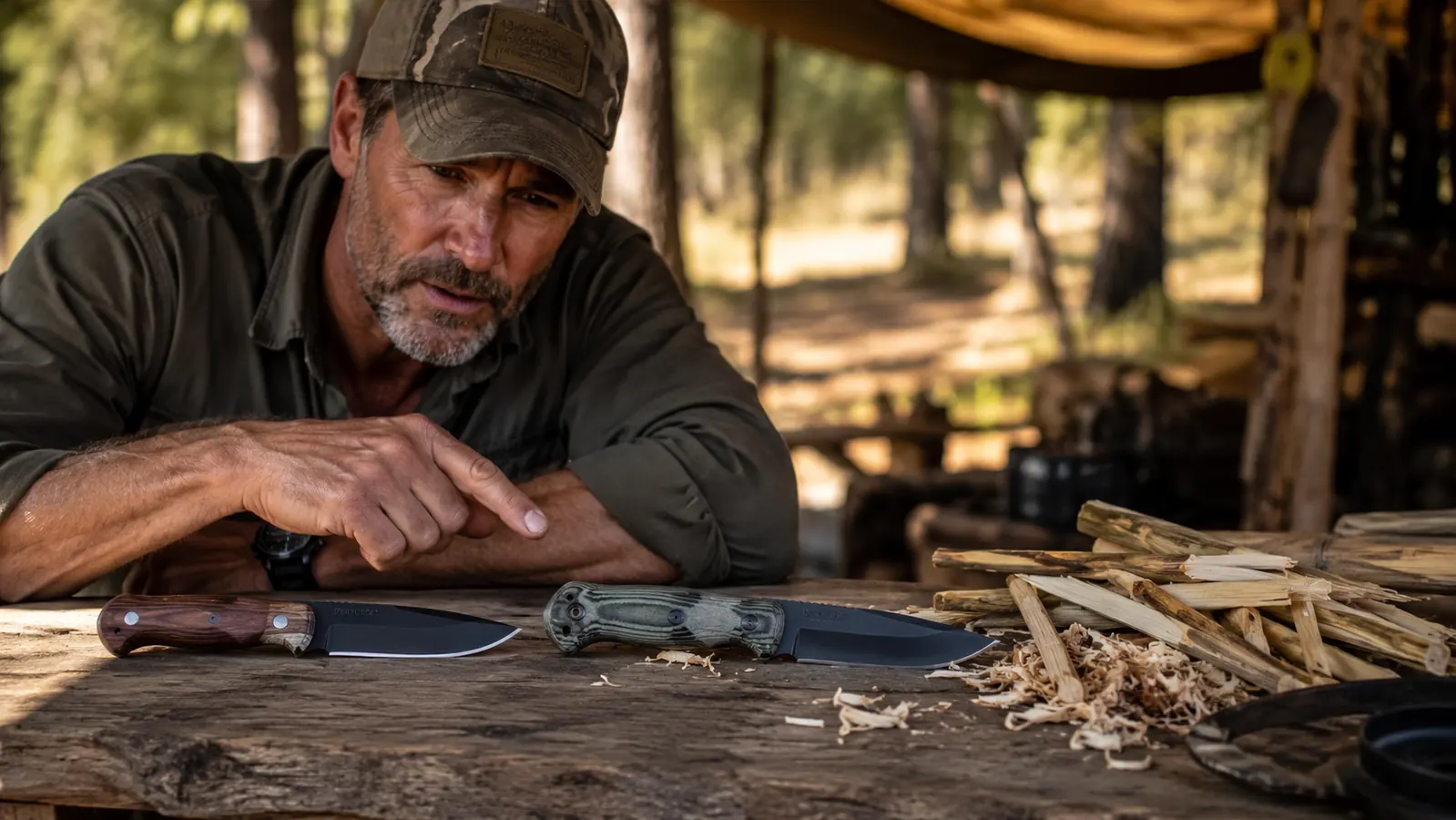
If you want the short answer before I get into the details: I keep the Mossy Oak 15-inch fixed-blade survival knife in my truck bag and my pack more often than any Morakniv I own, and it's the one I hand a buddy who shows up without a real knife. That's not a knock on Morakniv. I've carried a Morakniv Companion in one form or another for close to fifteen years, and it's earned every bit of the reputation it has in the bushcraft world. But these two knives aren't built to do the exact same job, and if you're standing in a store or scrolling a listing trying to decide between them, you need to know where each one actually pulls ahead before you spend your money.
I've run both of these hard enough, on enough different trips, that I've got a real feel for where the differences show up. It's not a case of one knife being junk and the other being gold. The Morakniv is a purpose-built bushcraft blade that does fine woodworking about as well as anything on the market at its size. The Mossy Oak knife is a bigger, heavier survival tool built to handle more jobs at once, batoning, field dressing, prying, striking a fire starter, without asking you to pack three separate pieces of gear to cover the same ground. Whether that trade makes sense for you depends on what kind of trip you're actually loading your pack for.
This isn't a comparison I put together off a spec sheet or a manufacturer's listing photo. I've had a Morakniv in one drawer or another of my truck for most of my adult life, going back to when a cousin brought one home from a work trip up north and swore by it for skinning squirrels. I picked up the Mossy Oak 15-inch fixed blade a couple years back mostly out of curiosity, since it kept showing up as a budget pick every time I looked for a backup survival knife to keep in a bag. What follows is what actually happened once I put both of them through the same wood, the same game, and the same cold mornings, not what either brand claims on the box.
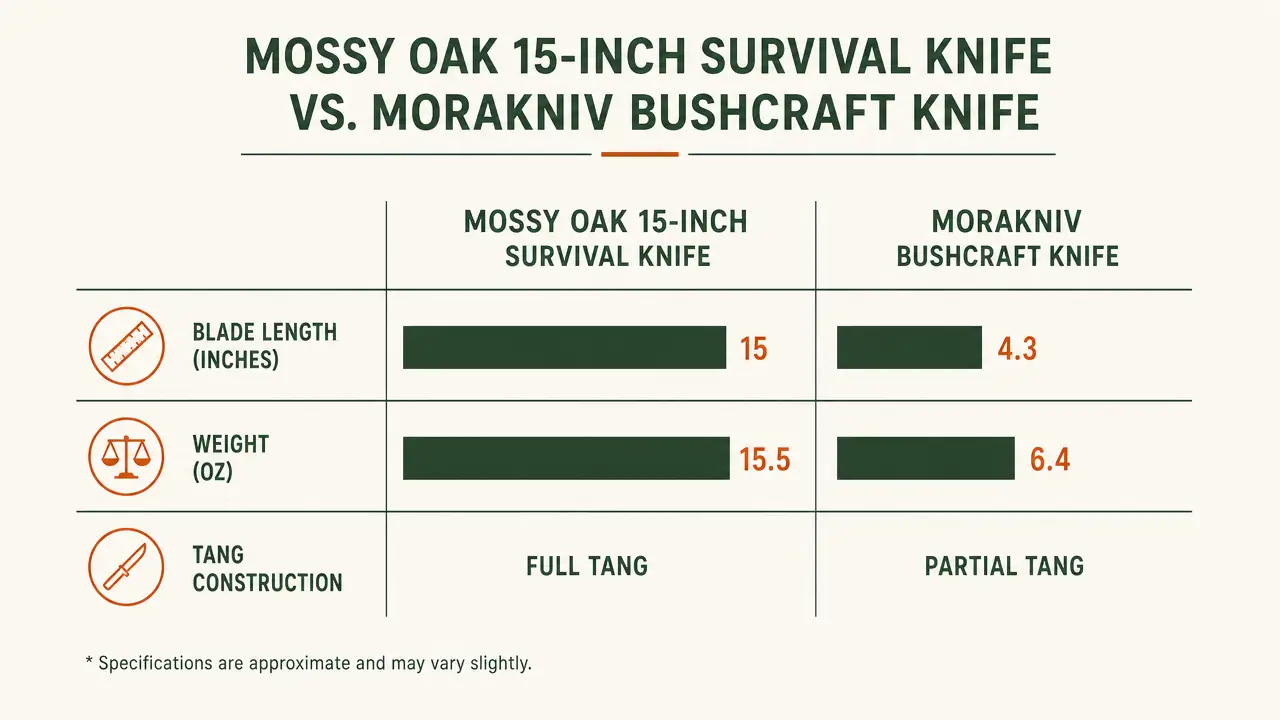
| Mossy Oak Survival Knife | Morakniv | |
|---|---|---|
| Blade Length | 6.5 inch drop point, 15 inches overall with the handle | 4.1 inch blade, about 8.6 inches overall |
| Steel | Stainless blade steel, softer but easy to touch up on a stone in the field | Scandinavian stainless or carbon steel, holds a fine edge noticeably longer |
| Tang | Full tang, the steel runs the entire length of the handle | Partial rat-tail tang, encased inside the polymer handle |
| Grind | Standard bowie-style flat grind | Scandi grind, a single flat bevel built for wood carving and easy field touch-ups |
| Sheath | Nylon sheath with belt loop and leg strap, holds the knife plus the sharpener | Molded plastic sheath, snug friction fit, no strap |
| Extras Included | Built-in ferro rod fire starter and a pocket sharpening stone | None, just the knife and sheath |
| Weight | About 12.8 oz with the sheath on | About 4.2 oz with the sheath on, much lighter for all-day carry |
| Best Use | Camp-duty survival tasks, batoning, field dressing, heavier field work | Fine bushcraft carving, food prep, and lightweight daily carry |
Where the Mossy Oak Knife Wins
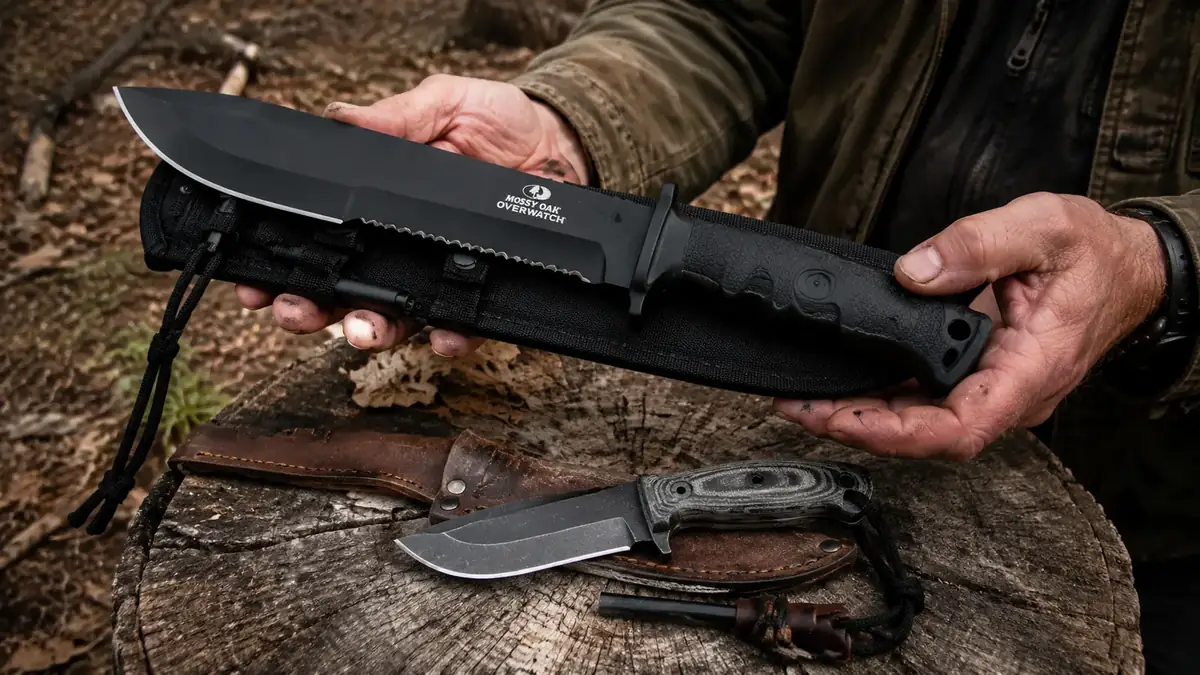
The first place the Mossy Oak knife pulls ahead is versatility, and for me that's the whole reason I reach for it more. That full tang means I'm not worried about the blade separating from the handle when I'm leaning on it hard, batoning through a forearm-thick piece of deadfall oak to build a fire on a cold morning. I've done that same job with a Morakniv and it holds up fine on smaller wood, but once you're working stock that thick, you feel the difference between a full tang and a rat-tail tang encased in polymer. The Mossy Oak just doesn't flex where the blade meets the handle.
The second edge it holds is what comes in the box. The built-in ferro rod on the end of the handle has gotten a fire started for me more than once when my hands were too cold to fumble with a lighter, and the little sharpening stone tucked into the sheath means I've never had to dig through my pack looking for a way to touch up the edge mid-trip. A Morakniv is a fine knife on its own, but it comes with nothing else. If you want a fire starter and a way to sharpen in the field, you're buying those separately and finding room for them. The Mossy Oak setup is one purchase that covers three jobs, which matters when you're trying to keep your kit simple and your pack light in every other category.
There's a third place it wins that doesn't show up on a spec sheet, and that's raw capability for rough work. I've used the point to pry open a stuck latch on an old ammo can, I've batoned kindling with it in weather that would've had me hunting for dry tinder for an hour otherwise, and I've field dressed a deer with the same blade the next morning after wiping it down. It's not the prettiest use of one knife, but it's honest use, and the Mossy Oak has taken all of it without complaint. That kind of do-it-all capability is exactly what a survival knife is supposed to offer.
Grip matters more than people give it credit for, too. The Mossy Oak's handle is textured and a little oversized, which I actually prefer once my hands are cold or wet from rain or sweat off a hike. A slimmer bushcraft handle can get slick in those same conditions, and I've had a Morakniv twist slightly in my grip during a wet cleanup job in a way the bigger knife never has. It's not a dramatic difference, but when you're working with a blade that size, you want every bit of confidence in your grip you can get.
Where the Morakniv Wins
The Morakniv's biggest advantage, and it's a real one, is the Scandi grind. That single flat bevel is built for controlled wood carving in a way the Mossy Oak's bowie-style grind simply isn't trying to be. If you're making feather sticks for a fire, carving tent stakes, or doing any kind of fine notch work, the Morakniv gives you a level of control the bigger knife can't match. I've sat at camp whittling a pot hanger with the Morakniv while a buddy struggled to get the same clean cut with a heavier blade, and the difference was obvious inside of two minutes.
The steel matters here too. Depending on which Morakniv you land on, you're getting either a laminated carbon edge or a solid Scandinavian stainless, and in my experience both hold a finer working edge longer than the Mossy Oak's blade does under the same use. It dulls slower doing detail work, though it's also a softer job to begin with, since you're not batoning full-size firewood with it the way you would with the bigger knife. For food prep, skinning small game, or anything where edge precision matters more than brute force, the Morakniv earns that reputation honestly.
Weight is the other clear win for Morakniv, and it's not a small one. At roughly a third the weight of the Mossy Oak with its sheath on, it disappears on a belt or in a pack in a way the bigger survival knife never will. My nephew carries one on every backpacking trip he takes because he counts ounces the way some guys count dollars, and he's never once told me he wished he'd packed something heavier. If your trips are built around covering ground rather than sitting at a camp doing heavier survival tasks, that lighter body is worth real consideration.
I'll also give Morakniv credit for the simplicity of the thing. There's nothing to rattle loose in that molded plastic sheath, no sharpener to lose track of, no fire starter rod to worry about snapping off. Some folks just want a knife that does one job well and doesn't ask them to think about anything else, and the Morakniv is about as honest a tool as you'll find for that kind of straightforward use.
Tired of packing a fire starter, a sharpener, and a knife as three separate pieces of gear?
The Mossy Oak 15-inch fixed blade comes with the ferro rod and sharpening stone built into the kit, so there's one thing to grab off the shelf instead of three.
Amazon Check Today's Price on Amazon →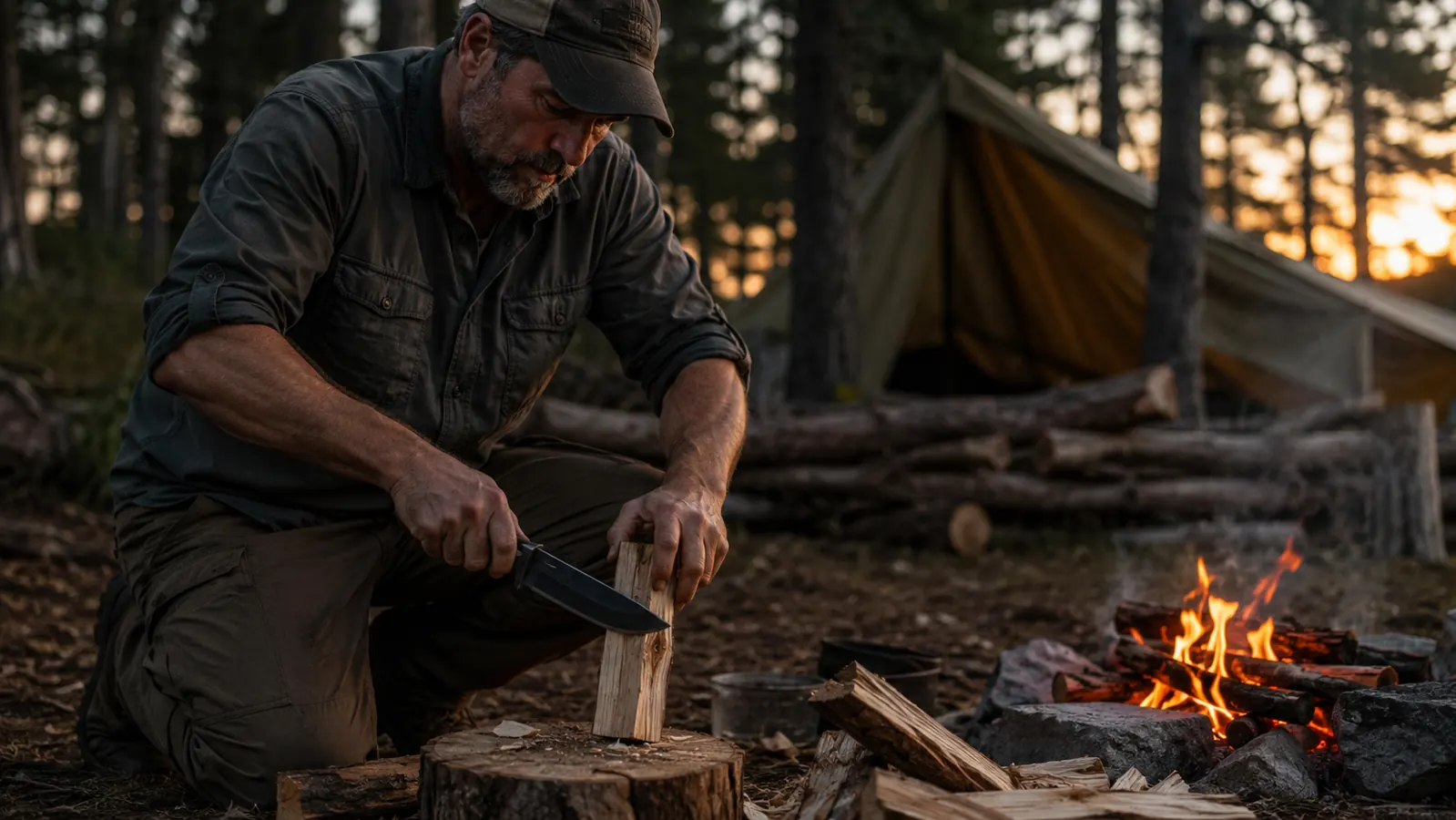
Who Should Buy Which
If you're after one knife to handle real survival duty, camp chores, batoning firewood, field dressing, prying when you need to, and you want the fire starter and sharpener already sorted for you, get the Mossy Oak 15-inch fixed blade. It's the one I keep in my truck bag and the one I hand a buddy who shows up without his own gear. If your priority is fine bushcraft carving, food prep, or shaving every ounce off a long pack-in trip, the Morakniv will serve you better and you won't miss the extra weight or bulk. Neither one is the wrong choice. They're just built to answer different questions.
I'd also say these two aren't mutually exclusive if you're outfitting your kit the way I've outfitted mine. My nephew and I have gone back and forth about this plenty of times sitting around a fire, and we've landed on keeping one of each in the truck. He grabs the Morakniv for carving and lighter camp chores, I keep the Mossy Oak for the heavier work, batoning, dressing game, anything that calls for a full tang and a bigger blade behind it. Neither of us feels shortchanged by the one he carries.
If you're brand new to fixed blades and only want to own one, think honestly about what your next few trips actually look like. A week of car camping with the kids, some firewood processing, maybe a fish to clean, points toward the Mossy Oak. A long solo hike where every ounce in your pack counts, and your main use is carving and food prep, points toward the Morakniv. I'd rather see you pick the right tool for your actual trips than the one with the better reputation on a forum somewhere.
Bottom line, and I mean this the way I'd say it standing at the tailgate with you: if you can only own one fixed blade and you want it ready for whatever the trip throws at you without buying extra gear to go with it, take the Mossy Oak. If weight and fine carving control matter more to you than doing heavier survival tasks with the same blade, the Morakniv won't let you down either. I just know which one is riding in my pack on the trips where I don't know exactly what I'll need it for.
Don't head out with a blade that can't handle whatever the trip actually throws at you.
The Mossy Oak 15-inch fixed blade is the one I hand anyone in my truck who forgot their own knife. Full tang construction, a built-in fire starter, and a sharpener already in the sheath.
Amazon Check Today's Price on Amazon →